The Real Cost of Building a SaaS Product in 2026 (and How to Do It for Under $5,000)
Everyone talks about the dream: build a SaaS, make passive income, escape the 9-to-5. Quit your job, ship fast, grow exponentially.
What they don't talk about is the bill.
I've been building teraatur.id — an employee management and attendance tracking tool for Indonesian SMEs — alongside my contracting work. And I've been tracking every dollar spent. This article is my honest breakdown of what it actually costs to build a SaaS in 2026, and the practical strategy I use to keep it under $5,000 before reaching first revenue.
The "Startup Cost" Myth
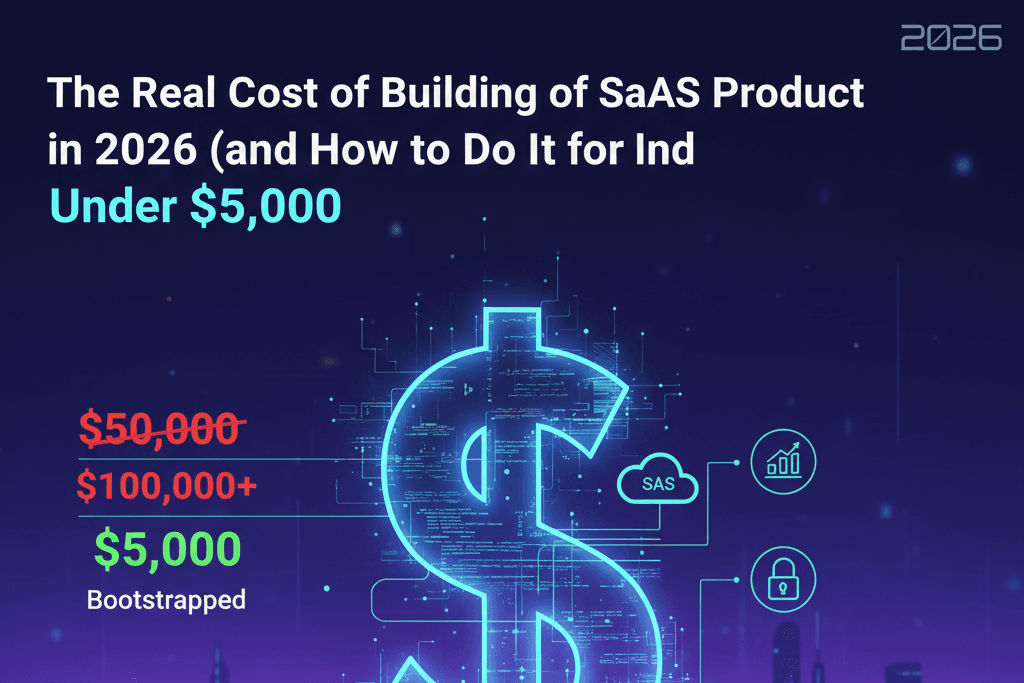
First, let's kill a myth: you don't need $50,000 to build a SaaS anymore.
In 2016, that might have been true. You'd need servers, a designer, a backend developer, and probably a DevOps person. In 2026, a solo developer with the right tools can ship a working product in weeks — not months — for a fraction of that cost.
But "cheaper than before" doesn't mean "free." And a lot of founders — especially first-timers — either dramatically underestimate costs or go the other direction and over-invest in infrastructure they don't need yet.
Here's what the real numbers look like.
The Actual Cost Breakdown
Year 1: Before You Have a Single Paying Customer
This is the danger zone. You're spending real money on something that hasn't proven itself yet. Let's break it down by category.
Infrastructure & Hosting (~$300–600/year)
The good news: modern cloud infrastructure is cheap if you use it right.
- Vercel (hosting): Free tier handles most early-stage apps. The Pro plan at $20/month is only needed when you're getting real traffic.
- Supabase (database + auth + storage): Free tier is genuinely usable. Their Pro plan ($25/month) becomes necessary when you cross ~50k monthly active rows or need daily backups.
- Domain: $10–15/year. Don't spend more than this.
If you're starting out, you can genuinely run on $0/month for the first 3–6 months using free tiers. I did.
Tools & SaaS Subscriptions (~$600–1,200/year)
This is where costs quietly accumulate. Here's my actual stack:
- AI coding tools (Claude, Cursor, or similar): $20–40/month. This is non-negotiable in 2026 — AI pair programming is a 2–3x productivity multiplier for solo founders.
- Design tool (Figma): Free tier works fine for early product work.
- Email (Resend or Loops): Free tiers cover your first 1,000–3,000 emails/month.
- Error monitoring (Sentry): Free for small projects.
- Analytics (Plausible or Umami): ~$9/month, or self-host for free.
The trap: subscribing to 10 "essential" tools before you have 10 users. I've seen founders spend $500/month on tools for a product that has zero customers. Pick one tool per category, use free tiers aggressively, and only upgrade when you have a concrete reason.
Design & Branding (~$100–500)
You have options here. You can:
- Use a premium template ($50–200) and customize it yourself — this is what I did for 90fri.day.
- Use Canva or Figma to design everything from scratch — free, but time-intensive.
- Hire a freelancer for a logo + color palette — expect $200–500 for something decent.
Skip the full brand agency. You don't need it yet. A clean, functional design beats a beautiful but half-built product every time.
Legal & Compliance (~$0–300)
For early-stage products:
- Privacy policy + Terms of Service: Use a generator like Termly or Iubenda. Free or ~$100/year.
- Business registration: Varies wildly by country. In Indonesia, you can operate informally as an individual first. In the US, an LLC costs $50–500 depending on your state.
- Contracts: If you're doing agency work alongside your SaaS, get a simple contract template. Clerky and similar services offer these for ~$100.
Skip the lawyer until you have revenue that justifies the cost.
Marketing & Acquisition (~$0–1,000)
Honest take: in the early days, your marketing budget should be close to zero. Here's why.
Paid ads before product-market fit is burning money. You don't know who your customer is yet. You don't know what message resonates. You don't know if people will stick around.
Instead, invest time — not money — in:
- Building in public on Twitter/X or LinkedIn
- Joining communities where your target users hang out
- Direct outreach to potential customers (manually, personally)
- Content marketing (like this article)
Once you have 10 paying customers and understand why they chose you, then you can test small ad budgets ($5–20/day) with a hypothesis.
Your Time (~priceless, but let's quantify it)
This is the biggest cost nobody includes in the spreadsheet.
If you value your time at your freelance/contractor rate — let's say $30–50/hour — and you spend 200 hours building your MVP, that's $6,000–10,000 in "opportunity cost." This doesn't show up in your bank account, but it's real.
The implication: be ruthless about what you build. Every feature you add is a decision to not spend that time elsewhere — on sales, on marketing, on customer conversations.
The $5,000 Budget That Actually Works
Here's how I'd allocate $5,000 to build and launch a SaaS product from scratch in 2026:
| Category | Budget | Notes | |---|---|---| | Infrastructure (12 months) | $500 | Vercel + Supabase Pro when needed | | AI coding tools (12 months) | $480 | ~$40/month | | Design template | $150 | Premium Framer or Tailwind template | | Logo & brand | $200 | Looka or freelancer | | Legal (privacy policy, ToS) | $100 | Generator tool | | Domain (2 years) | $30 | .com or relevant TLD | | Email marketing tool | $120 | 12 months of a starter plan | | Direct outreach tools | $120 | Apollo or similar for 3 months | | First marketing experiments | $500 | Small ad tests after first customers | | Buffer / unexpected costs | $800 | Things always come up | | Total | $3,000 | |
You'll notice I've budgeted $3,000 and called it $5,000. That's intentional. The remaining $2,000 is your emergency runway — customer refunds, unexpected server costs if you go viral, or simply extending your timeline by a few months if revenue takes longer than expected.
The Mistakes That Blow the Budget
In my experience — and from watching other indie hackers — here's what actually kills the budget before you get to revenue:
1. Over-engineering the tech stack
You don't need Kubernetes. You don't need microservices. You don't need Redis, a dedicated queue system, and three different CDNs. Start with Next.js (or your framework of choice) + a managed database + a single cloud provider. Scale when you have the traffic that demands it.
2. Building before validating
The most expensive thing you can build is the wrong product. Before writing a single line of code, talk to 20 potential customers. Not to sell them, but to understand their problem. I spent 3 weeks doing this for teraatur.id — visiting restaurants and cafes in Batam, asking owners how they track employee attendance. Those conversations shaped every product decision I've made since.
3. Hiring too early
I see this constantly. Founders raise a small amount (or worse, bootstrap) and immediately hire a designer, a marketing person, and another developer. Unless you have a very specific skill gap (e.g., you can't code at all), resist this until you have revenue.
4. Premium tools for zero users
You do not need Intercom at $74/month for a product with 5 users. You don't need the Growth plan on any platform until you're actually growing. Do a monthly audit: am I actively using this tool? Is it generating value proportional to its cost?
The Unfair Advantage of 2026
Here's what's genuinely different about building in 2026 vs. five years ago.
AI coding tools have become a legitimate force multiplier. A solo founder with Claude Code or Cursor can build what would have taken a 3-person team two years ago. Not because AI writes perfect code, but because it eliminates the research overhead, the boilerplate, and the "how do I even start this" paralysis.
I'm building teraatur.id — a full-stack SaaS with mobile attendance tracking, GPS check-in, admin dashboard, and Indonesian localization — while working a full-time contracting role, 10-20 hours a week on side projects. That wouldn't have been realistic in 2021. In 2026, it is.
The tools are cheap. The infrastructure is mature. The knowledge is freely available. The only real cost is your time, your clarity of thinking, and your willingness to talk to customers before falling in love with your own ideas.
The Honest Bottom Line
Can you build a real SaaS for under $5,000? Yes — if you're a developer, if you validate before you build, and if you're disciplined about what you spend money on.
But the cost isn't really the money. It's the months. It's the Saturday mornings and late evenings. It's the mental overhead of running a product while doing everything else in your life.
That's not a reason not to do it. It's just the thing worth being honest about before you start.
The upside, when it works, is that you've built something that generates revenue independent of your time. That's worth a lot.
Building in public at 90fri.day. Follow along as I document the process of building teraatur.id and other products from zero to first revenue.